Building National Capacities of Nepal to meet requirements of the Enhanced Transparency Framework of the Paris Agreement
Background
The Paris Agreement, adopted at the 21st Conference of the Parties to the United Nations Framework Convention on Climate Change (UNFCCC), aims to limit global average temperature to well below 2°C above pre-industrial levels and to pursue efforts to limit warming to 1.5°C. To achieve these goals, each country must reduce its national greenhouse gas (GHG) emissions while adapting to the effects of climate change. Each country must develop and implement Nationally Determined Contributions (NDCs) to reduce global greenhouse gas emissions. To facilitate the effective implementation of the Paris Agreement and build mutual trust and confidence among the Parties, Article 13 of the Agreement established an Enhanced Transparency Framework (ETF).
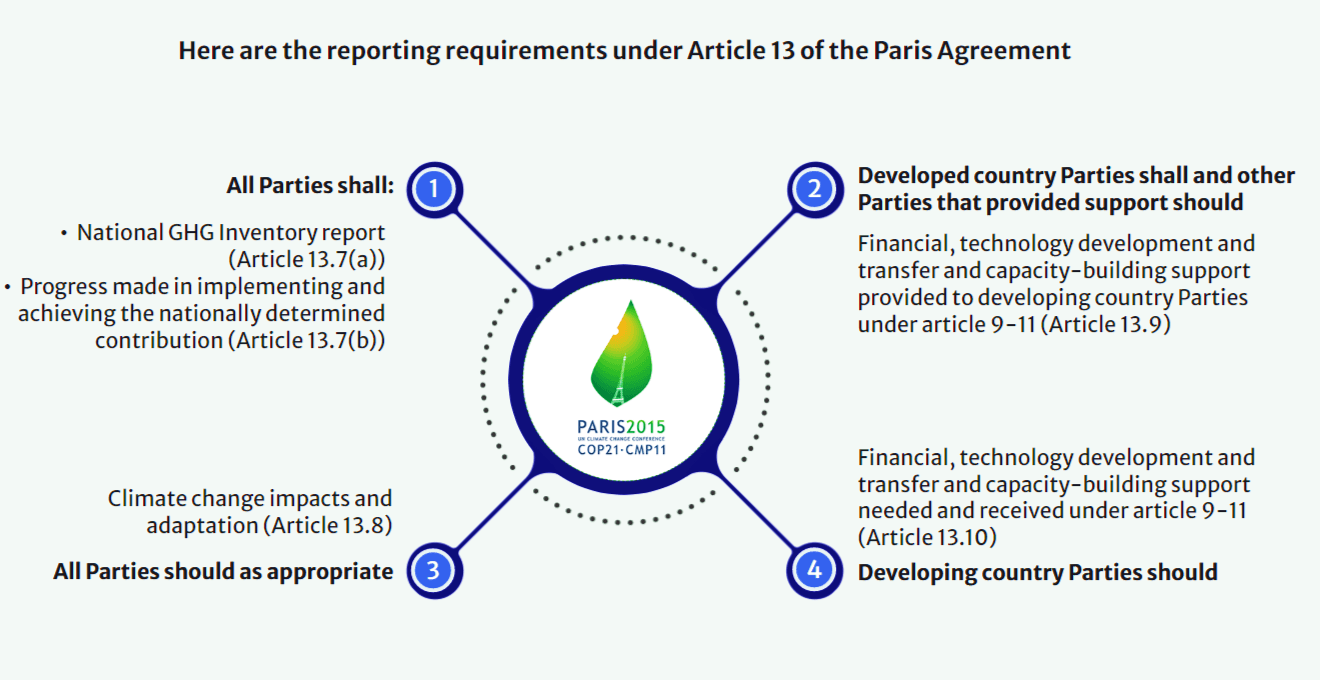
The ETF aims to provide a clear understanding of climate change actions and track progress toward achieving Parties' NDCs. The ETF requires each Party to provide a national inventory report of greenhouse gas emissions by source and removals by sink, information necessary to track progress in implementing and achieving its NDCs, and information on climate change impacts and adaptation. Transparency is complex, requiring technical knowledge, tools, and techniques for data generation and verification, access to data and methodologies, and overarching institutional and governance structures. Therefore, a Capacity-building Initiative for Transparency (CBIT) Fund was established with the Global Environment Facility (GEF) as the operating entity to support the Parties in meeting the transparency requirement. Through the CBIT Fund, developing countries can enhance their institutional and technical capabilities to meet the enhanced transparency requirements under the Paris Agreement.
The CBIT aims to:
Strengthen national institutions for transparency-related activities in line with national priorities.
Provide relevant tools, training, and assistance for meeting provisions stipulated in Article 13 of the Agreement.
Assist in the improvement of transparency over time.
CBIT Project in Nepal
Nepal submitted its national communication reports in 2004, 2014, and 2021 using 1994/1995, 2000/2001, and 2010/11 as its base years. The Third National Communication Report (TNC), submitted in 2021, provides the baseline information for the project. Building on this progress, the Government submitted its third Nationally Determined Contribution (NDC 3.0) to the UNFCCC in May 2025 and the country's first Biennial Transparency Report (BTR1) in June 2025. Both submissions drew significantly on this CBIT project, which supported the institutional arrangements for MRV, the national GHG inventory and tracking systems, and the technical capacity of federal and provincial agencies required to compile, quality-assure, and report the underlying data. Nepal also takes 'no regret' mitigation measures to reduce its GHG emissions. In line with UNFCCC decisions, these measures are expected to contribute significantly to Nepal's efforts to meet its mitigation and transparency obligations. As a signatory to the Paris Agreement, Nepal must transparently report on:
Mitigation actions and GHG accounting
Adaptation actions and national vulnerabilities
Technical Assistance and Technology transferred for adaptation and mitigation
International climate finance received, and domestic finance mobilized for mitigation and adaptation actions
The project, "Building National Capacities of Nepal to Meet the Requirements of the Enhanced Transparency Framework of the Paris Agreement," is executed by the Ministry of Agriculture, Forests and Environment (previously known as the Ministry of Forests and Environment, MoFE) and implemented by WWF Nepal with funding from the Global Environment Facility (GEF), with the goal of "strengthening capacities to meet the requirements of the ETF and tracking national progress against priority actions identified in Nepal's NDCs."
“strengthening capacities to meet the requirements of the ETF and tracking national progress against priority actions identified in Nepal's NDCs.”
Project Components
The project has four components. The first three components are programmatic pillars that directly lead to achieving the project's objective, while the fourth covers monitoring, evaluation, and knowledge management, tracking and documenting the project's progress, results, and challenges, and enabling adaptive management while ensuring effective learning and sharing.
This component addresses the barriers to establishing and maintaining national institutional arrangements for Measurement, Reporting, and Verification (MRV) of climate actions to meet Nepal's ETF requirements and support effective climate policymaking and implementation. Under this component, institutional arrangements for MRV will be established among relevant ministries at the federal and provincial levels, with clearly agreed-upon roles and responsibilities to ensure systematic data collection, processing, management, analysis, and reporting, as well as associated coordination among stakeholders.
This component aims to improve the overall framework for MRV of GHG emissions from all sectors, including agriculture, forestry, industrial processes, and waste. It will ensure the effective and innovative design of accounting rules, reporting guidelines, tools, and verification to ensure that Nepal's GHG emissions and removals are effectively monitored, progress is communicated, and greater ambition is generated for subsequent NDC updates. In line with the ETF, this component promotes capacity building across all GHG-emission sectors for data collection, analysis, monitoring, reporting, and verification.
This component is designed to address the barrier to tracking NDC implementation and reporting NDC progress on time. It will include a mechanism for tracking national climate actions, such as mitigation and adaptation, as well as climate finance received and mobilized.
Under this component, results and lessons learned from the project will be documented and disseminated within and beyond the project intervention through existing information-sharing networks and fora, drawing on lessons from CBIT and other transparency-related projects in countries with similar contexts.
Expected Outcomes
Institutional arrangements in place for coordinating, reporting, and communicating progress.
Strengthened MRV for reporting GHG emissions and assessing progress toward NDC commitments.
Enhanced national capacity for data collection, analysis, reporting, and verification for all GHG emission sectors (AFOLU, Energy, IPPU, Waste).
Monitoring and reporting of NDCs and means of implementation strengthened.
A project M&E system is established that tracks progress, assesses results, and informs project management in a timely manner.
Knowledge generated from the project implementation is managed through documentation and sharing of lessons learned.
Progress to Date
As of mid-2025, the project has delivered the following key results, which have directly supported Nepal's reporting obligations under the ETF:
Third Nationally Determined Contribution (NDC 3.0): technical and institutional support to the preparation of NDC 3.0, submitted to the UNFCCC in May 2025.
First Biennial Transparency Report (BTR1) and Biennial Update Report (BUR): support to the compilation, quality assurance, and reporting of the data underpinning Nepal's first BTR, submitted in June 2025, and its BUR.
National MRV document: a national MRV framework document prepared, setting out institutional roles, data flows, and reporting arrangements across sectors and levels of government.
MRV web portal: an online MRV portal developed to host, manage, and share climate data for national inventory preparation and NDC progress tracking.
Capacity needs assessment: an assessment of the capacity needs of sectoral institutions for preparing the national GHG inventory, used to target subsequent training and technical support.